Geological disposal of radioactive waste: a guide for communities
A guide for communities on how the UK plans to deal with its radioactive waste on a long-term basis and the process for identifying a site for a geological disposal facility.
What is the issue?
The UK has accumulated radioactive waste from a range of sources including generating electricity in nuclear power stations, using radioactive materials in industry, medicine and research, and from defence-related nuclear programmes.
Some of this material is in interim storage, but most still forms part of existing facilities and will only become waste over several decades as these plants are decommissioned and cleaned-up.
There are different categories of radioactive waste and it is the higher activity radioactive waste for which we need a secure long-term solution. Higher activity radioactive waste comprises a number of categories; high level waste (HLW), intermediate level waste (ILW), and some low level waste (LLW) that is not suitable for near-surface disposal in current facilities.
The UK Government is committed to implementing geological disposal for the safe and secure management of higher activity radioactive waste over the long term and favours an approach for selecting a site that is based on working in partnership with communities.
What is geological disposal?
Geological disposal involves isolating radioactive waste deep inside a suitable rock volume to ensure that no harmful quantities of radioactivity ever reach the surface environment.
The waste is contained inside multiple barriers to provide protection over hundreds of thousands of years.
It is not a case of simply depositing waste underground. The multiple barriers that provide safety for geological waste disposal are a combination of:
- the form of the radioactive waste itself, for example high level waste that arises initially as a liquid is converted into a durable, stable solid glass form before storage and disposal
- the packaging of the waste
- engineered barriers (buffer) that protect the waste packages and limit the movement of radionuclides if they are released from the waste packages
- engineered features of the facility that the waste packages are placed in
- stable geological setting (rock) in which the facility is sited
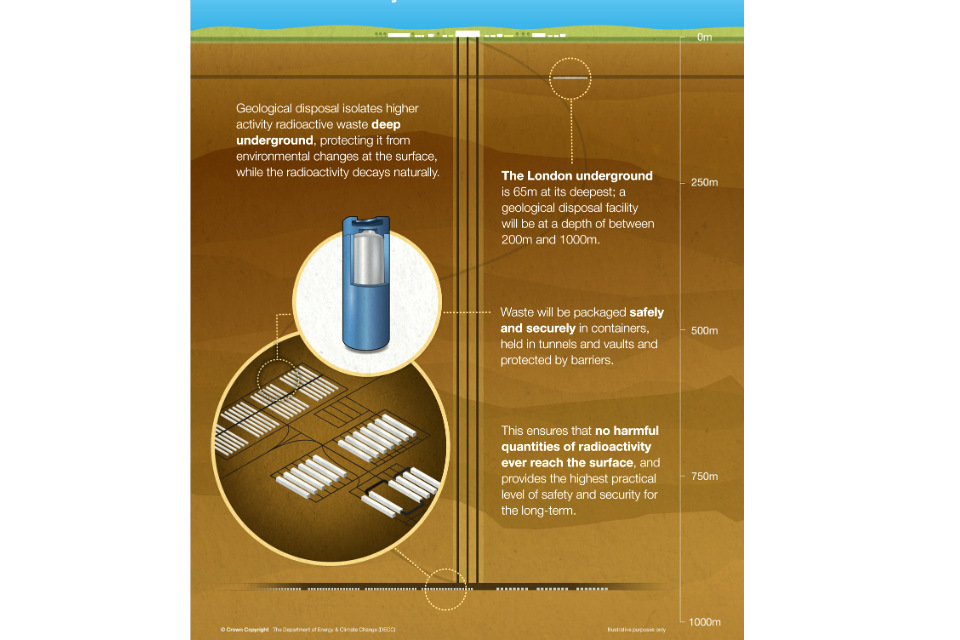
Figure illustrating depths of underground facilities
The approach
In July 2014 the government published a new White Paper – Implementing Geological Disposal. The White Paper details a renewed approach to implementing a GDF in the UK following a consultation in 2013.
Key principles
The Government and the developer of a GDF - Radioactive Waste Management Limited will engage with experts and the public to give clarity onthe key issues that people told us were of interest to them, such as:
- national geological screening
- national land-use planning for a GDF in England
- how communities will be represented, and
- what further investment communities can expect to see if they succeed in progressing through the site selection process
Specific actions set out in the White Paper between 2014 and 2016 include:
- bringing development of a GDF in England within the definition of a ‘Nationally Significant Infrastructure Project’ in the Planning Act 2008, including the production of a National Policy Statement and accompanying Appraisal of Sustainability
- a national geological screening exercise, which will consider what level of information is already available about geology across the country, how this could be usefully be related to the safety case for a GDF and how this could help the developer of a GDF engage openly with interested communities. To do this, the developer will draft national screening guidance that will be evaluated by an independent review panel, in an open and transparent manner, before being applied across the UK (excluding Scotland). Link here to RWM screening pages.
- work with experts and stakeholders to develop the detail of community representation mechanisms in the siting process, including a test of public support prior to final decisions on facility siting, and community investment.
All of this will happen before formal discussions between interested communities and the developer begin, so that any community wanting to engage with the process can do so with more information and greater clarity about the nature of a development.
Working with communities and investment - updated 3 March 2015
The UK government intends to work openly with experts in the field of community decision making in order to develop the detail of a process for working with communities.
A Community Representation Working Group (CRWG) is being set up to help DECC develop the mechanisms for working with communities within the GDF siting process in future. This work will cover issues including how to define ‘community’ or types of community, how to provide effective representation, governance and decision making, how to deliver a test of public support and how to manage and disburse community investment.
The group will be chaired by DECC, as the department responsible for the policy of geological disposal, and will have a core membership comprising the developer (Radioactive Waste Management), other relevant government departments, representatives with an insight into local government issues and academia. The CRWG will be supported by Local Partnerships, owned by HM Treasury and the Local Government Association who will gather evidence and literature on behalf of the group.
The CRWG is not a representative group promoting different interests; it is a group of people with expertise and experience to help develop recommendations on processes for working with communities.
The group’s work will be underpinned by a robust evidence base which will be developed through engagement with experts and stakeholders. Regular updates will be given on the progress of the work and a public consultation on the proposals will be held, if necessary. This page will be updated shortly with more information and details of how to get involved.
Construction and operation of a GDF will be a multi-billion pound project that will provide skilled employment for hundreds of people over many decades. A GDF will generate an average of 570 direct jobs over the duration of the project, with workforce numbers rising to more than 1,000 during construction and early operations. The UK Government will also make investment available early on in the siting processs to support communities that engage constructively in the process.
More detail on working with communities is available in Chapter 7 of the White Paper.
Likely timescales
We cannot be certain how long it will take to deliver an operational geological disposal facility, as the driver for the process is a partnership approach with potential host communities and will be dependent on discussions with local communities. But the following diagram is taken from the White Paper and provides an illustration of the likely timescales.
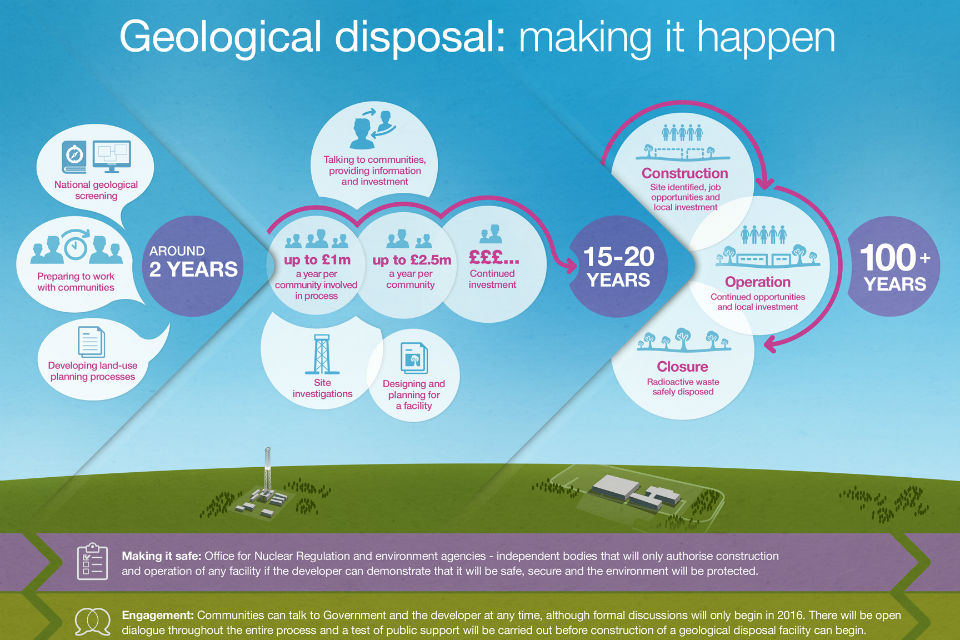
An illustration of likely timescales for the project
Regulation
The Government is committed to strong and effective control and regulation of the geological disposal facility development process. Robust, effective and independent regulation is vital for public confidence in a geological disposal facility programme which meets high safety, security and environmental standards based on comprehensive risk assessment and management.
The independent regulators the Office for Nuclear Regulation, and the relevant national environmental regulators: the Environment Agency, Natural Resources Wales, and the Northern Ireland Environment Agency will only allow a GDF to be built, operated and closed if they are satisfied that it will meet their demanding regulatory requirements. These requirements implement the protection standards established nationally and internationally.
The regulators will provide advice and regulatory comment to government, other authorities and the public. They are working together to build a common understanding of the regulatory issues involved in geological disposal.
The developer for a GDF, Radioactive Waste Management Limited (RWM) will need to demonstrate how a GDF meets demanding standards of safety, security, waste management and environmental protection. RWM is currently subject to voluntary regulatory scrutiny to ensure its technical work and organisational development meet regulatory expectations.
The Environment Agency has published guidance on requirements for authorisation of any future geological disposal facility. The guidance sets out the principles and requirements that a developer would need to address in developing an environmental safety case for a geological disposal facility.
Contact
Anyone looking for more information about geological disposal policy should contact DECC at ond@decc.gsi.gov.uk and Radioactive Waste Management Limited for technical questions at gdfenquiries@nda.gov.uk.
Links to further information
Last updated 24 July 2014 + show all updates
-
An update to the guide following the launch today of the White Paper on geological disposal.
-
Minor update to the guide incorporating content on regulation from the Environment Agency website following their move to GOV.UK.
-
Updated with reference to the call for evidence which was launched today.
-
First published.